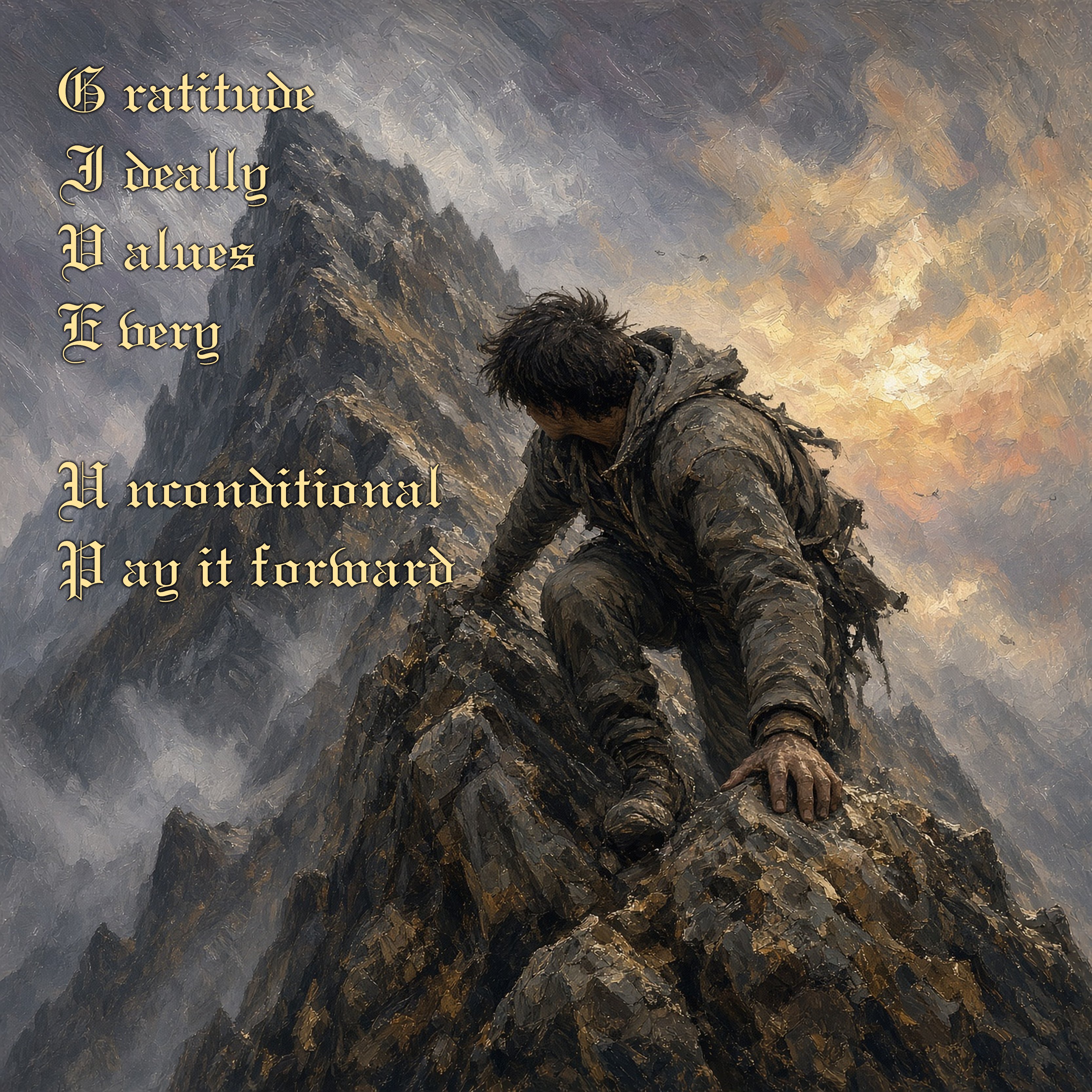
Gratitude begins in the quiet recognition that almost nothing we rely on is truly ours alone. A morning cup of coffee depends on soil, weather, growers, shippers, and the person who stocked the shelf; a kind word from a stranger depends on their willingness to notice us. When we practice gratitude, we stop treating these ordinary miracles as background noise and start treating them as the actual substance of a life. That shift does not require grand gestures. It can be as simple as pausing before a meal, naming one thing that went right, or remembering that the people who shaped us also carried their own unfinished struggles. Over time, the habit loosens the grip of scarcity thinking. We notice that what we have is already more than enough to begin giving something back.
Ideally, values are not slogans we hang on a wall but the quiet filters we use when no one is watching. Honesty, fairness, and care for others sound simple until they cost us time, money, or comfort. Living by them means accepting that some opportunities will close and that some relationships will stay limited. Yet the same values also open a different kind of space: the freedom to act without constantly calculating advantage. When a person decides, for example, that they will not speak about others in ways they would not say to their faces, daily conversations become cleaner and less exhausting. Ideally, these choices compound. They form a personal standard that does not need constant applause to remain intact.
Every act of unconditional regard carries a risk. To offer attention, patience, or practical help without first demanding proof of worthiness is to accept that the gesture may go unnoticed or even be taken for granted. That risk is real, and pretending otherwise leads to cynicism. At the same, the opposite posture—waiting until someone has earned our full respect—shrinks the circle of people we can actually reach. Unconditional does not mean boundaryless or endlessly available; it means the initial willingness to see another person as more than their last mistake or their current usefulness. In families, workplaces, and neighborhoods, that willingness often becomes the difference between isolation and a working connection.
It is practiced in small, repeated choices rather than in dramatic declarations. Paying it forward turns the earlier habits into motion. Gratitude reminds us we received something we did not fully earn; values tell us what kind of response is worth making; unconditional regard keeps the response from becoming a transaction. The resulting action can be modest: covering a shift for a coworker, listening longer than is convenient, or simply refusing to pass along a cutting remark. Because the original gift was never fully repayable, the natural next step is to extend a similar margin to someone else. Over months and years these gestures form a loose, living network.
They do not erase hardship, but they change the texture of ordinary days, making it slightly more likely that the next person will also find a reason to keep the chain moving. There is a kind of humility in this process—an understanding that we are part of something larger than ourselves, that our individual actions can ripple outward and touch lives we may never even know. In the quiet moments, when the world feels heavy and the weight of expectations presses down, these small acts of connection become a kind of relief. They remind us that we are not alone in our struggles, and that we are part of a web of human experience that stretches far beyond our own.
In the end, the practice of gratitude, the cultivation of values, and the embrace of unconditional regard are not just moral exercises—they are ways of living more fully, more gently, and more authentically. They invite us to move through the world with a sense of wonder, with a recognition that even the most ordinary moments can hold meaning. They teach us that generosity is not about grand gestures or public displays, but about showing up, again and again, with open hands and a quiet heart. This is the kind of life that leaves a mark, not because it is loud or dramatic, but because it is consistent, kind, and deeply human.
And so, the act of giving becomes a form of belonging. It is a way of saying, "I see you," and "I am here." It is a way of saying, "I am not alone in this." In the quiet space between these moments, the gift of giving finds its truest expression—not as an obligation, but as a choice. A choice to carry forward the light of gratitude, the strength of values, and the courage to offer unconditional regard. This is the heart of the practice, and it is the foundation upon which all else is built. It is not a burden, but a blessing. It is not a destination, but a journey. And it is, ultimately, a way of living that honors both the self and the world around us.
BACK  HOME